Connect CC Switch to Tokatlas
Before You Start
Install a current official CC Switch release and the client you want to configure. CC Switch manages configuration; the target client runs the agent.
Prepare a Tokatlas API key and a model enabled for your account. Replace all YOUR_... placeholders. Back up existing settings before merging changes.
Connection Settings
| Setting | Value |
|---|---|
| Provider name | Tokatlas |
| Protocol | Per-client protocol |
| Endpoint | See the compatibility requirements below |
| API Key | YOUR_TOKATLAS_API_KEY |
| Model ID | YOUR_TOKATLAS_MODEL_ID |
Setup
- Select the target application before adding a provider. Keep the imported default entry for rollback.
- Add a custom provider named Tokatlas. Use the protocol and address from the matching guide below.
- Enter your key and model ID, save, enable the provider, then restart the target client as required.
Locate the controls
The top icon row switches target applications; the orange + at the top right adds a provider. This upstream screenshot shows the Claude Desktop tab, not a configured Tokatlas account.
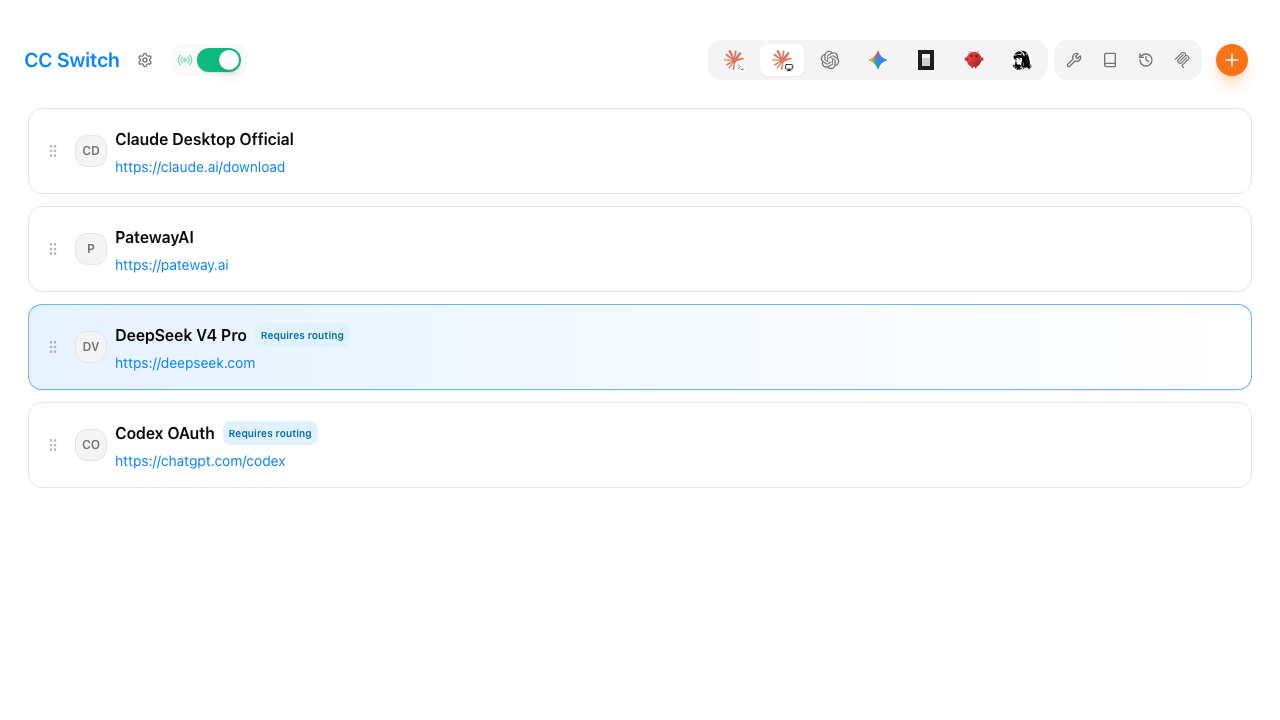
Screenshot source: CC Switch official documentation (unmodified; the interface may vary by version).
Compatibility Notes
Claude Code: Messages configuration. Codex: Responses configuration. Claude Desktop: 3P profile and model mapping. Gemini CLI: native API requirements. Switching one app does not prove every other app is configured.
Verify and Troubleshoot
- Open a new conversation and send “Reply with OK only”; check that text returns.
- Check Tokatlas usage for a successful request at the same time with the configured model.
- If you need tools, ask the client to list files in a test directory and check that the tool result returns to the conversation.
- If step 1 fails, test the key and model directly using API Basics. If that succeeds, troubleshoot client settings below.
| Problem | Check |
|---|---|
401 / 403 | Re-enter the Tokatlas key without quotes or spaces; check the auth mode and model access. |
404 | Compare the full request URL with the table above; remove a duplicated /v1 or endpoint suffix. |
| Unknown model | Copy an enabled ID from the model list, save it, and select that model in a new chat. |
| Tool failure | Model capabilities and client protocol support. |
| Changes ignored | Select the Tokatlas provider/profile, fully quit the client, and reopen it. |